
Back to school 2026: the state-by-state sex ed patchwork just shifted again
Every fall, students walk into a sex ed classroom that looks completely different depending on which state line they grew up behind. This year the map shifted again, in ways that cut both directions at once. Five more states now require sexual consent to be covered in sex ed curriculum than did last year, and […]

Every fall, students walk into a sex ed classroom that looks completely different depending on which state line they grew up behind. This year the map shifted again, in ways that cut both directions at once.
Five more states now require sexual consent to be covered in sex ed curriculum than did last year, and two more states added sex or HIV education mandates. That is real progress on paper. At the same time, two more states now require students to receive negative or no information about LGBTQ+ identities. The patchwork did not get simpler this year, it just moved.
A mandate is not the same as accuracy
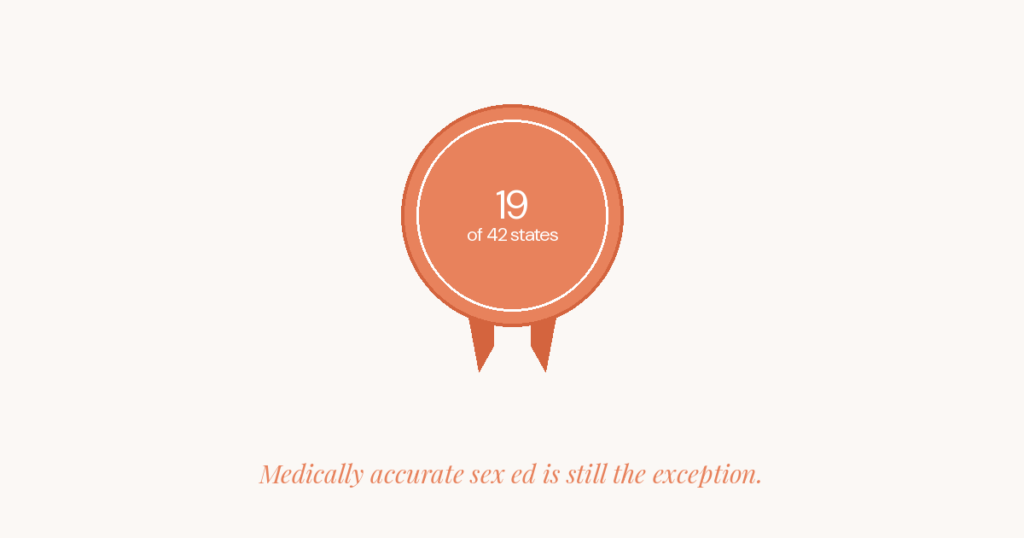
The headline number that matters most for students is this one, from a 2025 peer reviewed count published in the American Journal of Public Health: 42 states require sex education in at least one content area, but only 19 mandate that the content be medically accurate, and just 5 require parents to opt their kids in rather than opt them out. Most states default students into the class and leave accuracy optional.
That gap between “required” and “accurate” shows up most clearly in states that mandate HIV education while also requiring instruction that frames non-heterosexual orientations negatively. Alabama and Oklahoma are the clearest examples. Both require HIV education. Both also have long standing statutory language tied to portraying homosexuality unfavorably, sometimes alongside HIV transmission specifically. A student in one of these states can leave class having technically fulfilled an HIV education requirement while still walking away with stigmatizing, inaccurate framing of who is at risk and why.
Why this matters for college-age students specifically
Nearly half of all reported chlamydia, gonorrhea, and syphilis cases fall among people aged 15 to 24, and most young adults receive whatever sex education they are going to get before they finish high school, well before their own sexual debut in many cases. That means the accuracy gap in a home state’s curriculum follows students onto campus. A first year student who grew up in a state with a consent mandate and medically accurate content arrives with a very different baseline than a classmate from a state without either.
College and community health centers end up doing the catch up work, whether that is a student health center, an LGBTQ+ resource office, or a campus clinic. Knowing where your incoming students are starting from is not a small detail, it shapes what orientation programming and first semester outreach actually need to cover.
Whatever sex ed you got, testing is still yours to control.
Protecht pulls verified results straight from your provider, no falsifying, no guessing.
The bottom line
More states requiring consent education is a genuine step forward. But a state requiring a topic to be taught says nothing about whether what gets taught is true, complete, or free of stigma. Until medically accurate content is the standard everywhere rather than the exception in 19 states, the sex education a student receives will keep depending more on their zip code than on what the evidence actually shows.
Sources
- 2026 Sexual Education Curriculum Requirements in the US, Sex and Psychology
- Nelson et al., “The State of Sexual Education: State Laws and Regulations Mandating Sexual Education in the United States,” American Journal of Public Health, 2025
- Only 37% of US States Mandate Medically Accurate Sexual Education, Boston University School of Public Health
- States With Curriculum Laws Around LGBTQ Issues, NPR
- Sexually Transmitted Infections Surveillance data, CDC
Ready to bring your own?
Download Protecht and share verified status in seconds, not screenshots.

Carry your receipts, not just your word.
Pull your provider-verified results and share a negative status the safe way. Free to download.