
Only 10% of Women Got Tested Last Year — Here’s Why That Number Won’t Move Without a Real Conversation
The fifth edition of the Hologic Global Women’s Health Index came out this March, and one number in it is hard to look away from: only 10% of women surveyed said they had been tested for an STI in the past year. That is down slightly from the Index’s first year of tracking, meaning the […]

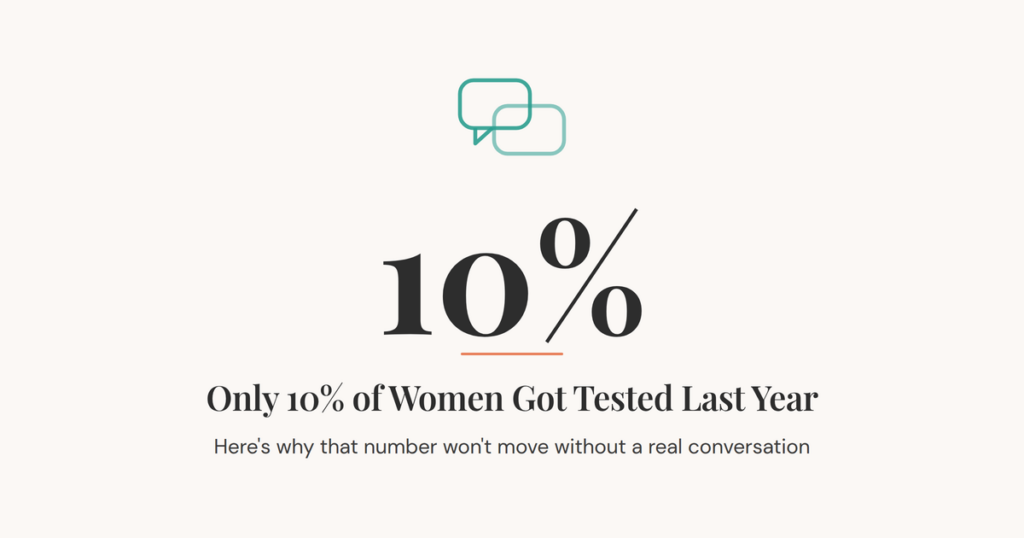
The fifth edition of the Hologic Global Women’s Health Index came out this March, and one number in it is hard to look away from: only 10% of women surveyed said they had been tested for an STI in the past year. That is down slightly from the Index’s first year of tracking, meaning the number has not meaningfully moved in five years of measurement. Not up. Not down in a way anyone would call progress. Just stuck.
That is not a story about women not caring about their health. It is a story about a system that has made testing feel optional, awkward, or simply beside the point, right up until it very much is not.
Why the Number Is Stuck
There is not one single reason 90% of women are not getting tested annually. It is a stack of smaller reasons that add up. Doctors often do not bring it up unless a patient asks first, and a lot of patients assume that if it mattered, their provider would have mentioned it. Annual physicals frequently do not include STI screening by default, especially for women who are not pregnant or not presenting symptoms. And the conversation itself, the one where you tell a doctor or a partner you would like to get tested, still carries a weight it should not, because testing has long been coded as something you do when something is wrong rather than something you do because your body deserves routine attention.
New guidance from King County Public Health, published this January, points at part of the fix. Rather than treating STI screening as a once-a-year box to check regardless of circumstances, the guidelines set a baseline of at least annual testing for sexually active people, then recommend more frequent testing, every three to six months, for anyone with risk factors that make a longer gap less useful. Those factors include things like a recent STI diagnosis, more than ten partners in the past year, or inconsistent barrier use. It is a more realistic model than a flat annual reminder, because sexual health does not move on a calendar. It moves based on what is actually happening in someone’s life.
The Missing Piece Is the Conversation, Not the Test
Testing itself has gotten easier over the past decade. Clinics are more accessible, at-home kits exist, insurance coverage has broadened in a lot of places. The bottleneck is not really access anymore, in most cases. It is the conversation around it: deciding to go, telling a partner why, and then, afterward, actually sharing the result with the people who need to know it.
That last step is where a lot of good intentions quietly stall out. Someone gets tested, gets a negative result, and then the information just sits in a patient portal or a paper printout that never makes it into an actual conversation with a partner. Not because anyone is hiding anything, but because there is no easy, low-stakes way to share it. Sending a screenshot feels either like overkill or like proof no one asked for. Saying “I got tested, I’m negative” out loud works, but it puts the whole weight of trust on the listener with nothing to verify it against.
This is the exact gap Protecht was built to close. A verified result, connected securely from participating labs, shareable with a partner in a few taps, no screenshot, no paper trail, no awkward follow-up questions about when exactly “recently” was. The testing part still happens the same way it always has, at a clinic, through a provider. What changes is what happens after: the sharing gets as easy as the testing should have been all along.
Moving the Number
If the 10% figure is going to actually move, and not just get reported on again next spring with the same disappointing footnote, it is going to take more than encouraging people to test. People need a reason that feels immediate, not abstract. Making the results genuinely useful, shareable, and easy to act on gives testing a payoff beyond a number on a portal nobody checks.
Routine testing paired with routine, low-friction sharing is what actually closes gaps like this one. Not another awareness campaign asking people to care more. They already do. What is missing is the infrastructure to make that care count for something the next time it matters, in a conversation with a partner who deserves real information instead of a guess.
Sources
- 1.5 Billion Women Miss Essential Preventive Tests, Despite Uptick in Global Screening Rates — Hologic Global Women’s Health Index, 5th edition, released March 17, 2026. Reports 10% of women surveyed had been tested for an STI in the past year, down 1 percentage point from Year 1 of the Index.
* 2026 HIV and STI Screening Guidelines — King County Public Health, published January 2026. Recommends at least annual STI screening for sexually active individuals, with more frequent testing (every 3-6 months) for those with risk factors including partner count, recent diagnosis, or inconsistent barrier use.
Receipts, not promises.
Turn your next test result into something you can actually share.


Carry your receipts, not just your word.
Pull your provider-verified results and share a negative status the safe way. Free to download.