
Three Ways to Bring This Up Before the Weekend
Big social weekend coming up. Maybe it’s Pride, maybe it’s just a normal Friday that turns into something more. Either way, if you’re meeting someone new, there’s a decent chance the topic of testing status crosses your mind and you’re not totally sure how to bring it up without it feeling like a whole thing. […]

Big social weekend coming up. Maybe it’s Pride, maybe it’s just a normal Friday that turns into something more. Either way, if you’re meeting someone new, there’s a decent chance the topic of testing status crosses your mind and you’re not totally sure how to bring it up without it feeling like a whole thing.
It’s worth bringing up anyway. CDC’s advice is to talk with partners before having sex so you can both make informed choices, and Planned Parenthood points out that most people with an STI don’t have any symptoms, so testing is the only way to know for sure. Asking isn’t an accusation. It’s just the only reliable way to get the answer.
Here are three ways people actually do this, without it being awkward.
1. Make it mutual from the start
“Hey, I like to share my test results with people before we’re intimate, mind doing the same?” This works because it’s not an accusation, it’s just a stated habit. You’re not asking them to prove anything to you specifically, you’re describing something you do for everyone. Most people respond well to that framing because it takes the pressure off being singled out.
Planned Parenthood frames it the same way: getting tested isn’t about cheating or not trusting someone, and you can say you want to do it because you care about your health and theirs. CDC adds that being respectful and nonjudgmental creates space for a more productive conversation, and makes the next one easier too.
2. Show yours first
Sometimes the easiest move is going first. “Figured I’d show you mine before we get further along” often gets the conversation moving faster than waiting for someone else to bring it up. Planned Parenthood suggests an opener in the same spirit: mention when you were last tested and what it showed, then ask whether they have been tested.
Include the date. A result reflects the day the samples were taken, so “negative in early October” tells your partner much more than “I’m fine.” Our post on what the date on a result tells you covers why.
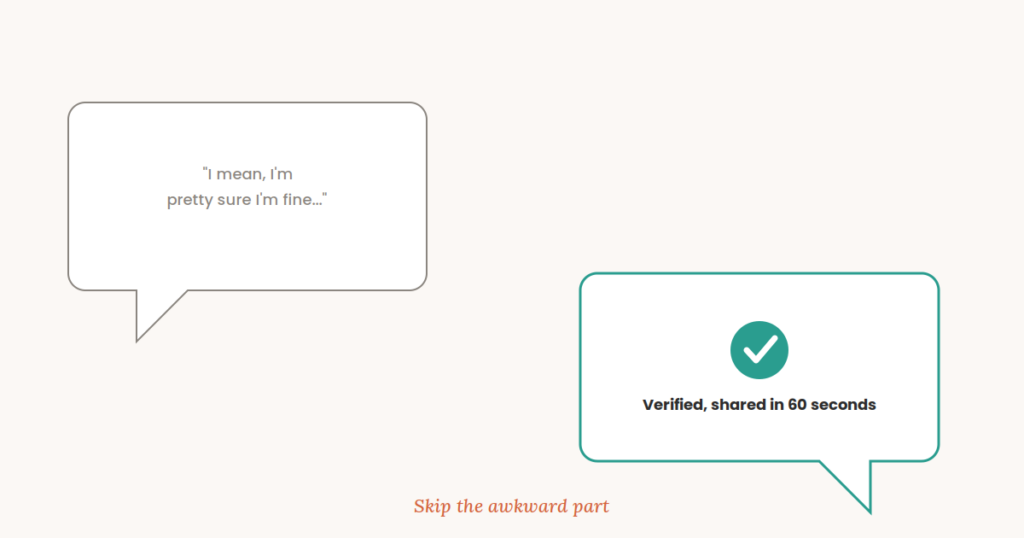
With Protecht, going first is quick. Your results come from your provider and can’t be uploaded or edited. You show them in person, phone to phone, for 60 seconds, and then the view expires, so there’s nothing to take back afterward.
3. Fold it into a bigger conversation
If you’re the type who prefers a broader check-in before things get physical, testing status fits naturally into that same conversation. It doesn’t need its own separate, heavier moment. “While we’re talking about this stuff, when did you last get tested?” is a pretty normal thing to ask once you’re already talking honestly about other things.
That question, “when were you last tested?”, is word for word one of CDC’s own conversation tips, along with a suggestion to consider getting tested together. If you want a fuller script that covers status, boundaries and consent in one go, try the STARS framework.
Skip the awkward part
See how Protecht shows results that come straight from your provider, in person.
If the answer is “a while ago”
That’s common, and it’s not a red flag on its own. CDC’s general guidelines say everyone aged 13 to 64 should be tested for HIV at least once, sexually active women under 25 should be tested for chlamydia and gonorrhea every year, and sexually active gay and bisexual men should be tested for syphilis, chlamydia and gonorrhea at least once a year, or every 3 to 6 months with multiple or anonymous partners.
If either of you is overdue, making a plan to test together is a good outcome of the conversation. CDC’s Get Tested locator lists free, low-cost and confidential options. If there was a recent exposure, check our guide to STI window periods so you test at the right time.
If they share a positive result
Thank them. Telling someone takes trust. As Planned Parenthood puts it, having an STI is simply a health issue, and it doesn’t mean anything about you as a person. Many STIs are curable, and treatment and safer sex lower the chances of passing on the ones that aren’t. From there, talk through what you’re both comfortable with. It’s also why we say “negative,” not “clean”.
However you bring it up, the actual sharing part doesn’t have to be complicated. A result that comes straight from a provider takes the guesswork out of the conversation. No one has to just take the other person’s word for it, and neither of you has to remember exact dates.
Sources
- Conversation Tips, CDC STI Awareness Week
- Getting Tested for STIs, CDC
- How Do I Talk With My Partner About STD Testing?, Planned Parenthood
- Get Tested: find a testing location, CDC
Receipts, Not Promises.
Download Protecht and show results that come straight from your provider.




Carry your receipts, not just your word.
Pull your provider-verified results and share a negative status the safe way. Free to download.