
Testing Before the Holidays: How to Time It and What to Keep
The holidays bring travel, parties and new people, and clinics change their hours. A little planning beats a rushed test the day before you leave. Here is a simple way to time a test, what to ask when you book, and what to do if plans change while you are away. It is general information, […]

The holidays bring travel, parties and new people, and clinics change their hours. A little planning beats a rushed test the day before you leave.
Here is a simple way to time a test, what to ask when you book, and what to do if plans change while you are away. It is general information, not medical advice.
Start from the date you need the answer
Work backward. Think about the first day you expect to be with someone new, or the day you travel, and ask what a result would need to tell you by then.
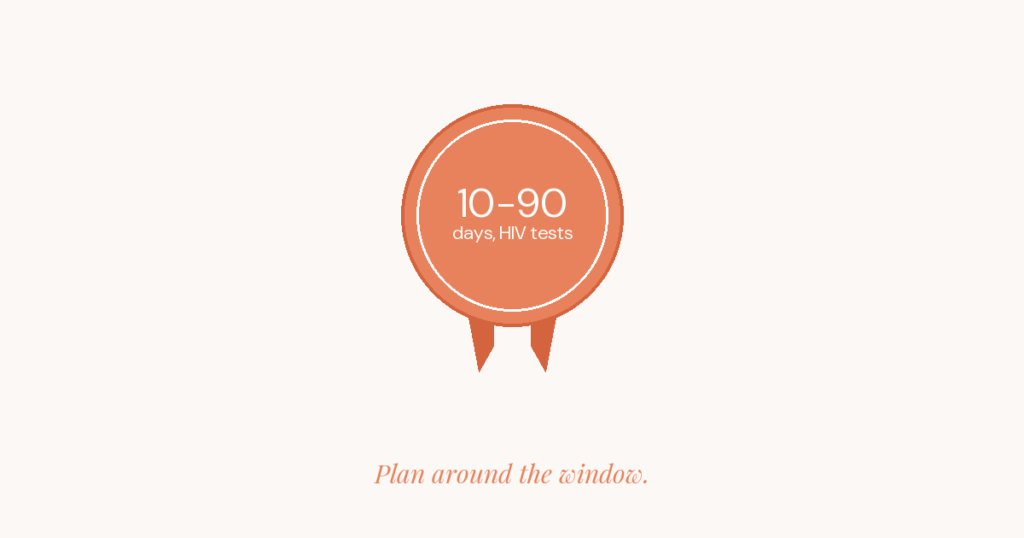
Testing the day before is not always the most useful move, because a test can only find what is detectable on the day it is taken. For HIV, the CDC says a nucleic acid test can usually detect it 10 to 33 days after exposure, a lab antigen/antibody test 18 to 45 days, and an antibody test 23 to 90 days. If you test negative before the window period for your test has passed, the CDC says to get tested again after it.
Other infections have their own timing, and our window period timeline walks through it. The point for planning is simple: a test taken well before you travel and a test taken after a recent exposure answer different questions.
Book early and ask how results arrive
Appointments fill up before long weekends, and results can take a different amount of time depending on the test and the lab. When you book, ask when results are usually ready, how they are released to your patient portal, and whether the provider connects to Apple Health. What to bring to an STI test has a short checklist.
Put the next test on the calendar
Protecht sets testing reminders on the schedule that fits you, so a test before the holidays does not slip.
Know what to do if plans change
If something happens while you are away and it involved a possible HIV exposure within the last three days, do not wait for a test window. The CDC says post-exposure prophylaxis, or PEP, should be started as soon as possible and no later than 72 hours after exposure. If your usual clinic is closed for the holiday, a local urgent care, emergency department or health department can tell you where to be seen.
A result is a snapshot, so keep the date
A negative result describes the day the sample was taken, not the days after. What the date on a result tells you explains why. The line that does the work is: tested on this date, negative for these infections, next test due on this date.
If your provider connects to Apple Health, your results can be downloaded to your iPhone under Health Records, so the dated result is with you when you travel. Protecht reads from Apple Health and has no upload button, so results in Protecht come from your provider and cannot be edited. It can only show what Apple Health receives, so coverage varies by provider and by test. How sharing works with Apple Health Records has the details.
Sources
- Getting Tested for HIV, CDC
- Antiretroviral Postexposure Prophylaxis After Sexual, Injection Drug Use, or Other Nonoccupational Exposure to HIV: CDC Recommendations, United States, 2025, CDC MMWR (May 8, 2025)
- About the privacy and security of your health records, Apple Support
Ready to bring your own?
Results in Protecht come from your provider and can’t be uploaded or edited, so what you share is the real record.



Carry your receipts, not just your word.
Pull your results from your provider and share a negative status the safe way. Free to download.