It’s easy to read a headline like that and move on. It happened somewhere else, with a product you’ve probably never used. But it’s worth sitting with for a second, because it points at something bigger than one test kit.
The gap between “I tested myself” and “a provider confirmed it”
At-home testing has done a lot of good. It’s lowered the barrier to getting tested at all, especially for people who feel uneasy walking into a clinic or who don’t have easy access to one. That matters, and it’s not going away, nor should it.
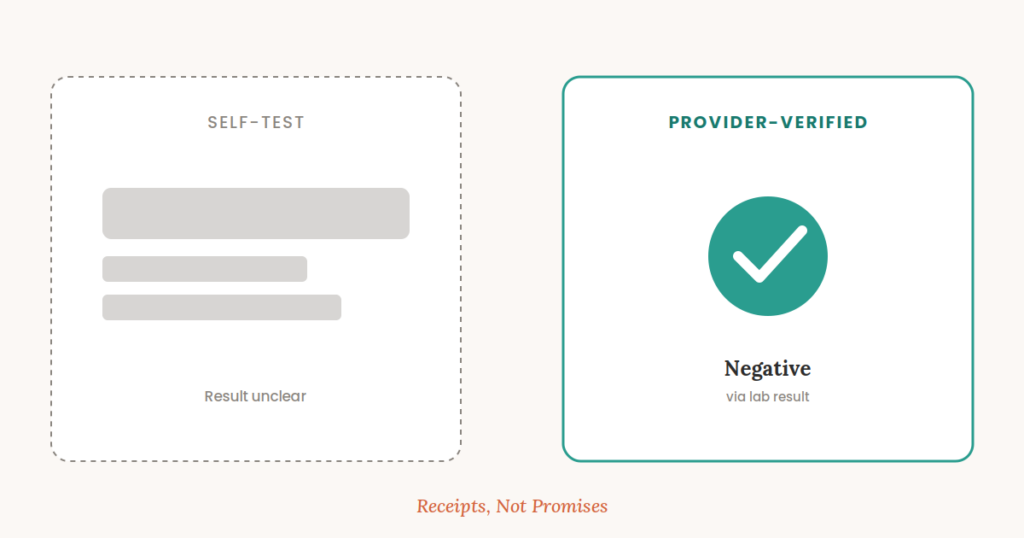
But there’s a difference between a result you read off a test strip in your bathroom and a result that’s been processed by a certified lab and confirmed by a provider. Most of the time, that difference doesn’t show up in any meaningful way. Sometimes, like in this case, it does. Reading a line on a card is not the same thing as a nucleic acid amplification test run through certified lab equipment. Neither approach is inherently wrong. They’re just not interchangeable, and it matters which one you’re relying on when you tell a partner what your status is.
This isn’t about scaring anyone off self-testing, and it isn’t a case against the technology. It’s about being honest with yourself, and with the people you’re intimate with, about what you actually know versus what you’re assuming.
Why the distinction rarely gets talked about
Part of the reason this gap goes unnoticed is that most sharing happens informally. A text message. A verbal “yeah, I got tested, I’m good.” Nobody’s asking whether that result came from a home kit read by eye or a certified lab report, because the question itself feels intrusive or overly clinical for the moment it comes up in.
That informality is exactly where false confidence creeps in. A false negative on a home test doesn’t announce itself. It just quietly sits there, indistinguishable from an accurate one, until it isn’t.
Why this is the whole idea behind Protecht
Protecht doesn’t ask you to self-report anything, and it doesn’t take your word for a result you read off a card. When you connect your provider (Kaiser, Quest, LabCorp, or another Apple Health-connected system), your results come straight from the source, the same lab result your doctor sees on their end. Nothing gets typed in, nothing gets guessed at, and nothing gets left up to how well you read a test strip in bad bathroom lighting.
- Provider-verified only, no self-reported results, ever
- Pulled directly from your provider’s system via Apple Health
- Read-only sharing, results can’t be edited or faked
- 60-second access, then it disappears from their screen
When you share a result with a partner, what they see is what the lab actually found. Not “I think I’m negative.” Not a screenshot that could have been edited or is months out of date. The real thing, verified, visible for 60 seconds, then gone.
That’s the whole idea. Receipts, not promises.